
A Voyage Through Gallipoli History: The GA’s Portsmouth Regional Conference
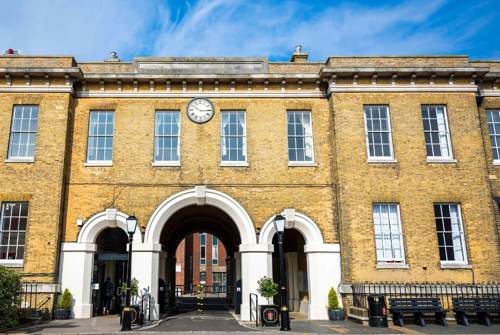
This year’s Gallipoli Association’s Regional Conference headed to the south-east of England, taking place in Portsmouth, Hampshire. Bathed in glorious sunshine, the venue, Portsmouth Grammar School (PGS), welcomed around 50 delegates who gathered to hear seven outstanding speakers.
The programme featured a mix of traditional 45-minute presentations and shorter ‘20-minuter’ talks. The speakers explored a wide range of fascinating subjects, from the fledgling submarine service and the Royal Naval Air Service (RNAS) to daring wartime exploits, treasured family heirlooms, and reflections on Gallipoli in the context of modern military doctrine.
Our first speaker, GA member Malcolm Avery OBE, a retired Commodore and former Royal Navy submarine commander, delivered a fascinating presentation entitled “A New Breed of Warrior – Submariners in the Dardanelles.”
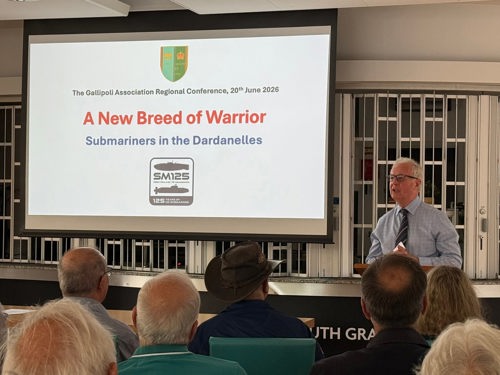
Malcolm explored the story of those pioneering submariners who, despite initially being viewed with suspicion and often marginalised within the Royal Navy, emerged as a vital and innovative fighting force. He guided the audience through their hazardous missions in the Dardanelles, arguing that their successes offered some of the few glimmers of hope during an increasingly troubled campaign. From famed submariners such as Holbrook, a former PGS alumnus, to Brodie, Stoker, Boyle, Bruce, Nasmith, Warren, Cochrane, Pirie, Stocks, and many others, Malcolm brought to life the courage, ingenuity, and determination of these remarkable men. Their exploits, often carried out under extraordinary conditions, provided a compelling insight into one of the most daring aspects of the Gallipoli campaign. Unsurprisingly, Malcolm’s book Hellespont – Through the Jaws of Death proved to be a popular purchase during the breaks, with many attendees keen to learn more about this extraordinary chapter of naval history.
Our next speaker was the GA’s Historian and Chairman-elect, Stephen Chambers, who presented a talk entitled “Valour, Bravery and Torpedoes – For Services in Picket Boats.”
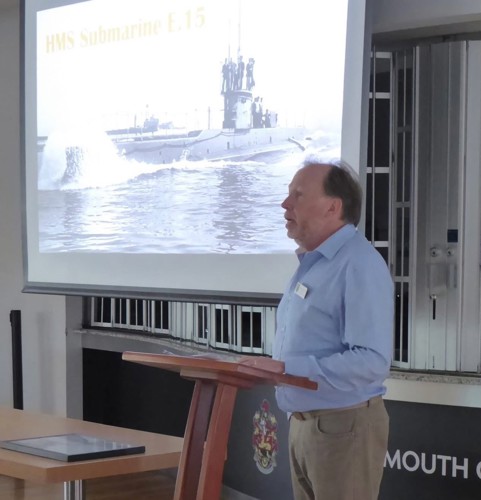
Through the experiences of Able Seaman William Longworth, Stephen recounted the dramatic story of the mission to destroy HM Submarine E.15 after it had run aground and fallen into Turkish hands. The operation was an exceptionally hazardous undertaking, carried out by volunteers who understood the risks involved. While the exploit is most often associated with the then Lt-Cmdr Eric “Kipper” Robinson VC, Stephen’s presentation offered a fresh perspective by telling the story through the eyes of one of the ordinary sailors who took part. In doing so, he highlighted the courage, determination, and professionalism of the men whose contributions are often overshadowed by the better-known figures of the campaign.
From the fledgling submarine service and picket boats, attention then turned to the skies. The GA’s Youth Ambassador, Sophie Haworth, shared some of her research into “Gallipoli Air Power”, focusing on the trailblazing work of the Royal Naval Air Service.
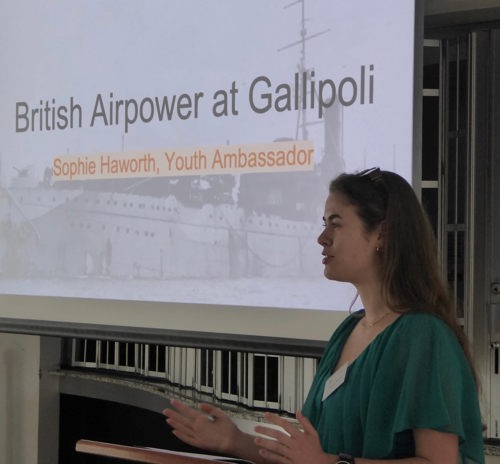
As true aviation pioneers, these intrepid men pushed the boundaries of emerging technology in their efforts to gain an advantage over the Ottoman forces. Employing an innovative mix of seaplanes, balloons, airships, and even armoured cars, they adapted rapidly to the demands of a new form of warfare and helped establish Allied air superiority in the Gallipoli theatre.
Before breaking for lunch, GA member Guy Lewin Smith shared the story of his grandfather, an officer in the 1/5th Suffolks, with his talk “My Grandfather’s Compass.”
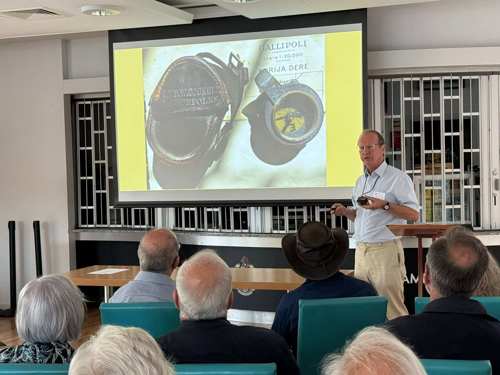
Tracing his journey from his home in Framlingham, through his education at Cambridge, and ultimately to his first experience of battle at Suvla, Guy brought his grandfather’s story vividly to life. The presentation was particularly engaging because it was enriched by personal artefacts and family history, including his grandfather’s military compass, which he carried during the Gallipoli campaign, and which remains in the care of his family today. This tangible link to the past added a special dimension to a fascinating and memorable talk.
After lunch, GA member Brian Cleary delivered an excellent presentation, “Lily Doughty-Wylie - how two medals revealed an incredible story”.
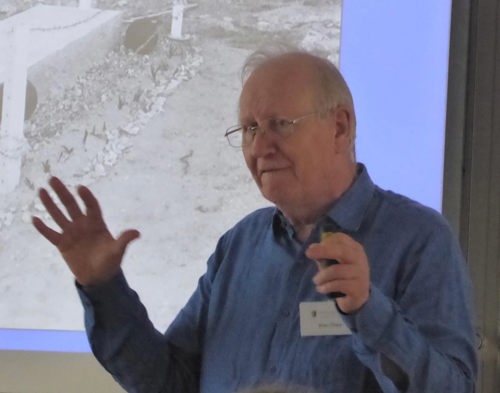
Lily was the wife of Lt-Col Charles “Dick” Doughty-Wylie VC, famed for his actions at V Beach. Brian skilfully explored the background of this remarkable couple, as well as Dick’s relationship with Gertrude Bell, providing fascinating insight into the complex personal stories of the Wylie’s. Brian also shared details of his research into solving the mystery of the only woman known to have landed on Gallipoli during the campaign. The stories of both Lily and Gertrude reveal two extraordinary women whose lives and achievements deserve wider recognition. The presentation was both engaging and thought-provoking, and left the audience looking forward to the publication of Brian’s groundbreaking book on Lily.
Following Brian’s presentation, the GA’s own Events Coordinator and Quartermaster, Hester Huttenbach, shared the remarkable story of her father, Col Norman Huttenbach DSO, OBE, MC, who served as a captain in B Battery, Royal Horse Artillery, at Helles.
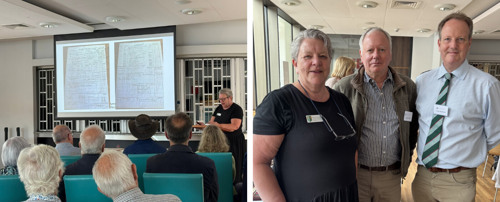
Her talk “A Father’s Story” was fascinating. Adding an unexpected connection to the occasion, two other relatives of Royal Horse Artillery officers who served at Gallipoli were also in the audience. One was the great-nephew of Major General C. P. W. Perceval CB, DSO, who was then serving as a captain in L Battery, RHA, and the great-great-nephew of Major General H. R. Peck CB, CMG, DSO, who was then a major in the same battery. It was fascinating to reflect that, 111 years after the campaign, descendants of these officers were gathered to share and discuss the experiences of their forebears.
Following Hester’s presentation, GA member Roger Cooper Simpson delivered a talk entitled “Bound for Somewhere.”
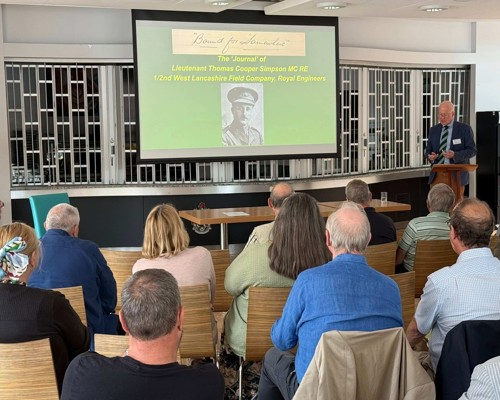
Any presentation that includes Gully Ravine, mine craters, and trench maps is almost guaranteed to capture an audience’s attention, and Roger certainly did not disappoint. Drawing on the diary of his grandfather, a subaltern in the Royal Engineers at Gallipoli, Roger guided us through his experiences during the First World War. Through this personal account, he explored how many aspects of his grandfather’s service resonate with modern military practice. From the familiar phrase “hurry up and wait” to observations on training, welfare, readiness, and security. He also noted how remarkably forward-thinking the Field Service Regulations (1909) were, drawing comparisons with the modern concept of Mission Command, and showcased examples of early combined-arms operations. In areas such as command and control, operations, combat engineering, and logistics, the principles underpinning military activity in 1915 were often surprisingly familiar, although in other respects they have evolved dramatically.
Stephen closed the conference, offering the GA’s sincere thanks to all the speakers, the school and everyone who attended and continues to support the GA and its mission. Events such as this are only possible through the dedication and hard work of a committed team. Special thanks went to Hester, whose organisational skills are second to none and whose efforts were instrumental in making the conference such a success. The GA were also grateful to Stephen for assembling an excellent line-up of speakers and putting together the day's programme. Finally, thanks went to Sophie, who not only delivered a fascinating presentation but also had the honour of opening the conference at her former school.