Merchant Taylors’ School Marks the Return of Gallipoli Hero’s Victoria Cross
Earlier this month our chairman, Brigadier James Stopford CBE, attended a special event held at Merchant Taylors’ School, Northwood to mark the return of George Drewry’s Victoria Cross.
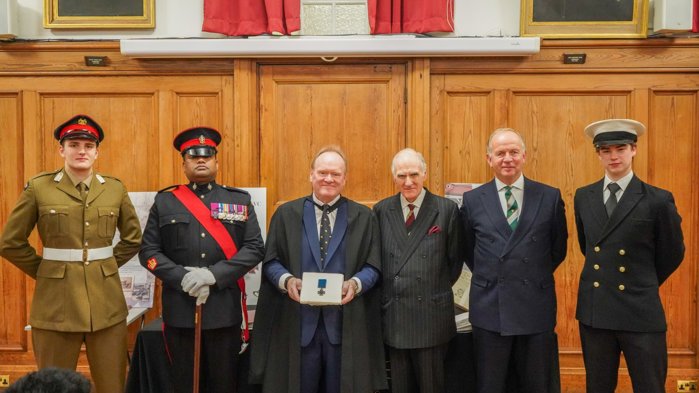
Photo caption: From left to right: Cadet Under Officer Ben P; WO2 Johnson Beharry VC; Simon Everson, Head Master; Marshal of the Royal Air Force, the Lord Stirrup KG GCB AFC; Brigadier James Stopford CBE, Gallipoli Association; Cadet Warrant Officer Magnus C.
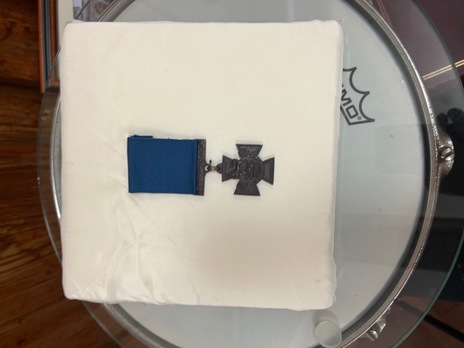
Merchant Taylors’ School, Northwood, has marked the return of alumnus Midshipman George Drewry’s Victoria Cross, following almost 30 years on display at the Imperial War Museum. A special ceremony was held at the School on Thursday, bringing together members of the Drewry family, alumni, governors, the Court of the Merchant Taylors’ Company, and representatives of the Gallipoli Association and the VC and GC Association.
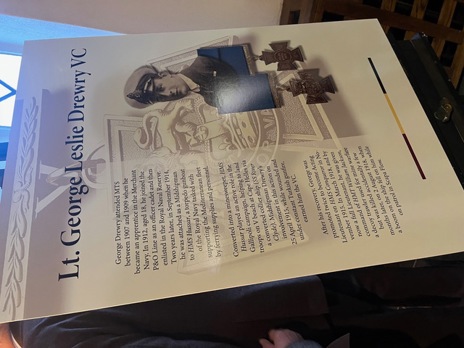
The event honoured Drewry’s extraordinary bravery during the Gallipoli landings on 25 April 1915 and reaffirmed the School’s commitment to remembrance and to the enduring values of courage and character. The date held particular significance: it marked 109 years since Drewry returned to the School to show staff and pupils the medal he had received only days earlier from King George V.
Drewry, who attended Merchant Taylors’ from 1907 to 1909, earned the Victoria Cross for his actions under fire at Cape Helles as a Midshipman on HMS Hussar. He was later promoted rapidly through the ranks before being killed in an accident in Scapa Flow in 1918.
The School was especially honoured to welcome WO2 Johnson Beharry VC, a serving soldier and one of only a small number of living holders of the honour. Attending as a Merchant Taylors’ parent, he carried the Drewry VC at the close of the ceremony - an emblematic moment linking two remarkable stories of courage across generations.
Cadets from all three Combined Cadet Force sections formed an honour guard, with readings delivered by Cadet Under Officer Ben P and Cadet Warrant Officer Magnus C. Marshal of the Royal Air Force, the Lord Stirrup KG GCB AFC - an alumnus of the School - read from Field Marshal Baron Bramall’s 1996 address marking the medal’s original loan to the Imperial War Museum.
Head Master Simon Everson said:
“This is a special moment in the history of Merchant Taylors’ School. Welcoming George Drewry’s Victoria Cross back to Merchant Taylors’ is both a privilege and a profound moment of reflection for our community. His courage and sense of duty speak directly to the values we seek to instil in our boys today.”
General Sir Gwyn Jenkins, First Sea Lord, also paid tribute, saying:
“Midshipman George Drewry’s actions at Gallipoli exemplify the finest traditions of the Royal Navy. The return of his Victoria Cross to Merchant Taylors’, with Johnson Beharry VC in attendance, brings together the legacy of a valiant recipient who gave his life in service and that of a living holder of this distinguished honour - a rare and moving tribute to duty and sacrifice.”
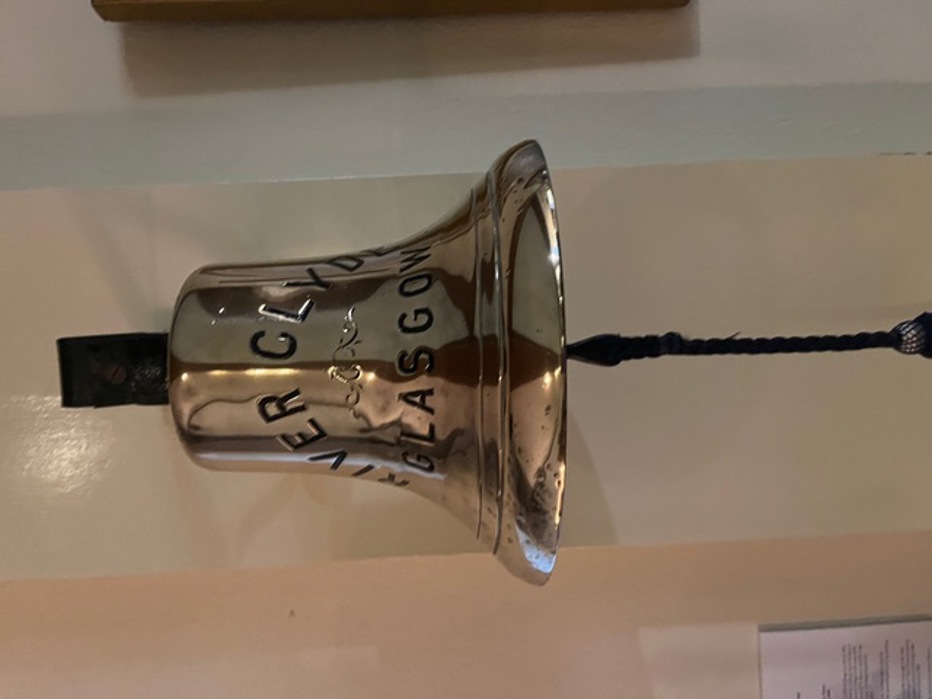
The Victoria Cross returns to Merchant Taylors’ alongside an important suite of artefacts bequeathed to the School in 1969 by Herbert P. Drewry, including a recently conserved family scrapbook of newspaper cuttings, the bell from the SS River Clyde, and a painting of the vessel by Ralph Drewry, the youngest brother.
Several members of the Drewry family were present, including some who attended the 1996 handover ceremony at which Field Marshal Baron Bramall, then Chairman of Trustees at the Imperial War Museum, accepted the medal for its long-term loan.
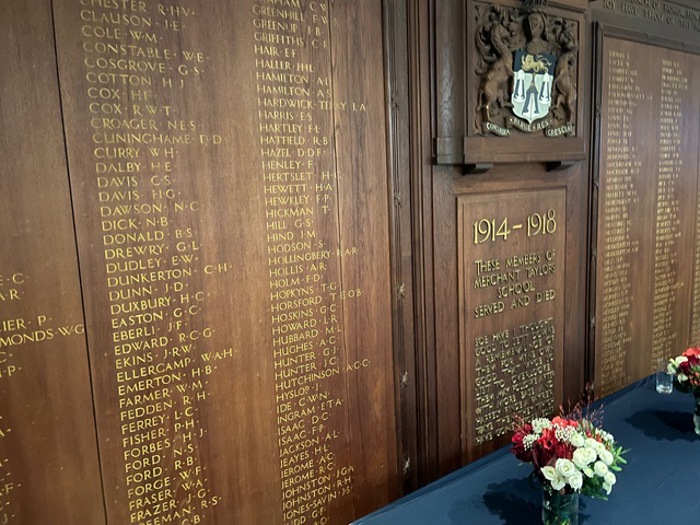
The return of the medal marks a significant moment for Merchant Taylors’ professionally managed archive and its ongoing work to preserve and share the history of Old Merchant Taylors. The medal will be securely stored offsite, with a replica and selected artefacts displayed at the School to ensure that Drewry’s story - and the service of the 1,820 Old Merchant Taylors who served in the First World War, including the 311 who lost their lives - remains visible to future generations.
Brigadier James Stopford, Gallipoli Association chairman, wrote that it was a huge privilege to attend the event, and remarked that:
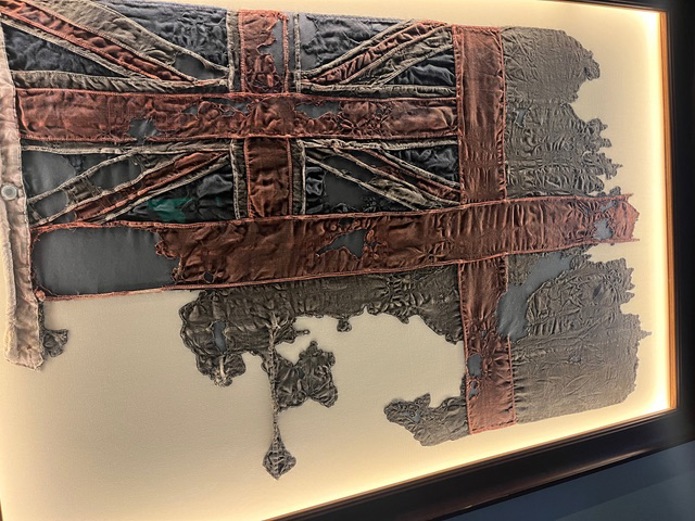
“… they have a wonderful collection of Gallipoli memorabilia including SS River Clyde's Ships Bell and the ensign flown by HMS Rattlesnake which was badly shot up during the campaign. I attach my modest photos below.”
The Gallipoli Association has been in correspondence with the School since, in particular to the story of the SS River Clyde’s bell. Many ships at the time had multiple bells, often including one large main bell for timekeeping and signalling, and one or more smaller bells for different purposes like internal announcements or fog signals. For example, the Titanic had two bells on its mast, and modern U.S. Navy ships typically have at least two or three bells. The smaller of two ship bells was called a quarterdeck bell and was used for marking watches and making ship-wide announcements, while the larger bell on the forecastle was used for fog signals and calling the crew to meals. On modern ships, the smaller bells can also be found in the pilot house. Knowing that there are at least two bells in existence, the Gallipoli Association is helping the school with confirmation that theirs, is the larger main bell, the smaller version being held in a Suffolk museum.
Here is also a link to the story on our website and to the video on our YouTube channel:
Return of Midshipman Drewry's Victoria Cross
Thanks to Merchant Taylors’ School for allowing us to publish a short report of the event, the images and the link to the video.